Your renewal notice showed up, and the premium went up again. Same house, same roof, same square footage. So why is homeowners insurance so expensive in Texas?
You’re not imagining it. The average Texas homeowners policy cost $1,987 in 2020 and $3,489 in 2025, according to the Texas Department of Insurance. And Texas A&M’s Real Estate Center found Dallas-Fort Worth has the highest average premium of the state’s big metros.
The hard part is that your premium is three problems stacked on top of each other, and you only control some of it. So most people either pay whatever the renewal says or cut coverage to shrink the number. The first costs you money every year. The second can leave you short on the one day you actually need the policy.
Here’s what’s driving the bill, starting with the part you can’t control, then the three moves that actually lower it.
Why is homeowners insurance so expensive in Texas? Three reasons
1. Hail, and North Texas sits right in the middle of it
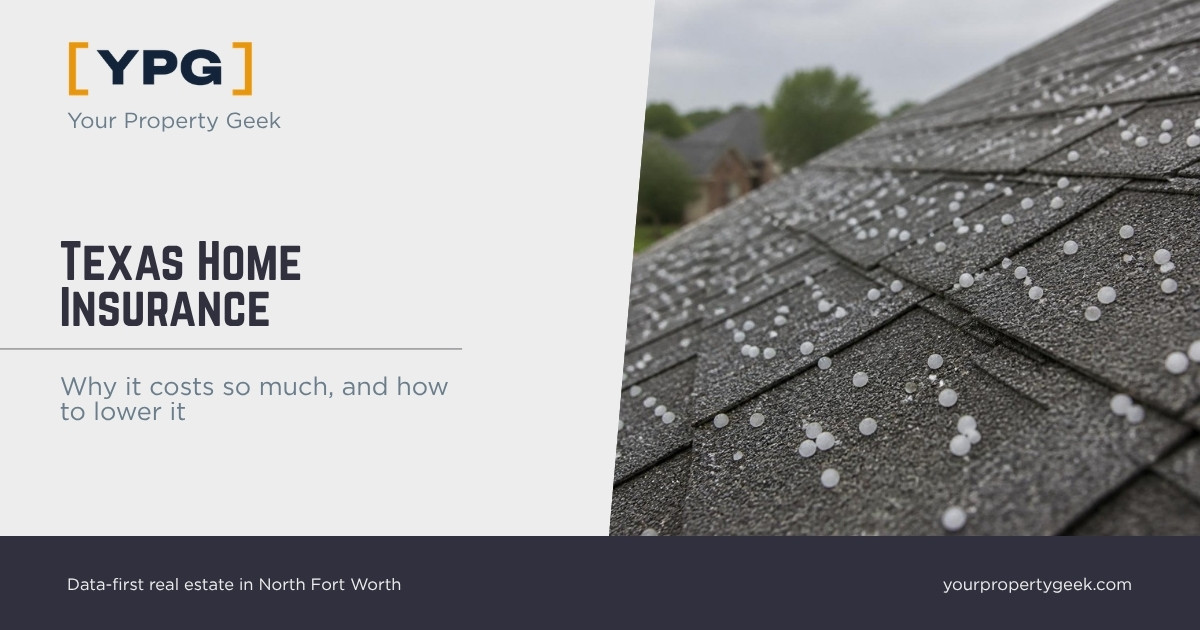
Wind and hail are the most expensive things that happen to Texas homes. Together they’ve made up about 62% of homeowners insurance losses in Texas since 2019.
You can’t move out of hail country. Spend your energy on the parts of the bill you can change.
2. Your house costs more to rebuild
Your policy is priced on what it would cost to rebuild your house, and that number has climbed fast. The average Texas policy covered $294,900 in 2020 and $432,800 in 2025.
That one change explains about two-thirds of the premium increase. The price per $1,000 of coverage rose too, but only about 20%. Some of the coverage growth is newer, bigger homes, and some is the rising cost of labor and materials.
Don’t fix that by cutting your dwelling coverage. The policy limit is what you’ll rebuild with after a fire or a tornado. Ask your agent when your rebuild cost was last updated instead.
3. The rates, even after insurers’ best year in a decade
Rebuild costs don’t explain all of it. Texas homeowners rates rose 21% in 2023 and 19% in 2024. Insurers lost money on Texas homes in 2021 and 2023, and those increases were meant to make it back.
Then came 2025. Insurers kept about 23 cents of every premium dollar as underwriting profit, their best Texas year in at least a decade. The state’s largest home insurer, State Farm Lloyds, made about $541 million on Texas homeowners policies, then filed a 4% increase for renewals starting Nov. 1. The Texas Department of Insurance asked it to justify the increase given its 2025 results and lower reinsurance costs.
I’m not against insurers making money. They had real losses to cover. But if your renewal goes up after their best year in a decade, ask why, and check what everyone else charges.
Three moves that actually lower the bill
Move 1: Shop your renewal
This is the first year in a while that shopping has real pull. Of the homeowners rate changes Texas insurers have filed since July 1, 26 were cuts and only 5 were increases. Your company may not be one of the cuts.
Start about 60 days before your renewal and get at least three quotes. The state’s HelpInsure.com lets you compare sample rates and each company’s complaint record. Then compare the declarations pages, line by line. A cheaper quote often means a bigger deductible or less coverage on your roof.
And don’t sit on real storm damage to protect your rate. Texas insurers can’t charge you more for a weather claim. File it when it’s real.
Move 2: Pick your deductible on purpose
Most North Texas policies now carry a separate percentage deductible for wind and hail, and 2% is the norm. It’s figured on your dwelling coverage, so the size of the repair doesn’t change it. On a $450,000 policy, you pay the first $9,000 of storm damage.
A higher deductible lowers your premium. Only take one if that cash is already sitting in savings.
While you’re on that page, check how your roof is covered. In Texas, insurers can’t drop you for the age of your roof alone, but roof age can still affect your price, and some companies pay older roofs at actual cash value. Actual cash value means the roof’s depreciated value. On an older roof, depreciation plus a 2% deductible can leave you paying for most of the replacement yourself. Find out which one you have before the next hail season.
Move 3: Hire a roofer with integrity
This one’s personal. A roofer once quoted me about $12,000 to replace a roof. When I asked him to put it in writing, he wouldn’t. If the insurance adjuster came back with a higher number, he wanted to bill that instead.
Most replacement-cost policies pay up to what the repair actually costs. A roofer who bills the insurer’s estimate instead of his real price pads the claim, and padded claims end up in the next rate filing. Texas has seen enough of this that it’s illegal for a contractor to waive, rebate, or absorb your deductible, and a roofer can’t act as your insurance adjuster.
I’m not against a roofer making a profit, even a healthy one, as long as it’s made the right way. When overbilling insurance becomes normal practice, homeowners pay for it in their premiums. So get the real price in writing before the adjuster comes out, pay your own deductible, and walk away from anyone who offers to “take care of it” for you.
Buying? Make the roof part of the deal
Lenders won’t close without homeowners insurance, and a damaged roof can make a house hard to insure. That puts the roof near the top of any repair request.
Earlier this year, my buyers in Saginaw got an inspection report full of small items, the kind most buyers don’t need to worry about. Plenty of them were easy DIY fixes my clients were happy to handle themselves. So instead of handing the seller the whole report, we narrowed it to the five items that mattered for living there safely and getting the house insured.
The roof had real hail damage, and when that’s the case, the smart move is to run it through the seller’s insurance first and find out whether the insurance company will pay for it before it comes out of anyone’s pocket. That’s what we asked for here, and the sellers agreed, taking care of my clients’ biggest concern.
My buyers got an insurable house with a brand-new roof, and they even got to pick the color. If you’re buying, get an insurance quote during your option period, and ask about the roof’s age and claim history before you write your repair request.
What to do before your next renewal
You can’t control the hail, and you can’t make your house cheaper to rebuild. You can control the rest. Insurers just had their best Texas year in a decade, and most of the rate filings since July have been cuts, which gives you room to push back.
So pull out your declarations page this week. Check your dwelling coverage, your wind and hail deductible, and how your roof is covered. Then set a reminder for 60 days before your renewal to get quotes, and the next time a roofer knocks on your door after a storm, ask them to put their price in writing before the adjuster comes out.
And if you want help sorting through quotes or your coverage, I have trusted insurance agents and advisors I can refer you to. Shoot me an email, and I’ll connect you.
Frequently asked questions
Why is homeowners insurance so expensive in Texas?
Wind and hail are the biggest drivers, at about 62% of Texas homeowners losses since 2019. Rebuilding costs also climbed, and rates rose 21% in 2023 and 19% in 2024.
What is the average cost of homeowners insurance in Texas?
$3,489 a year in 2025, according to the Texas Department of Insurance. That’s up from $1,987 in 2020.
Can my insurance company drop me because my roof is old?
Not for age alone. Texas insurers can’t decline or nonrenew a policy based only on the age of your home or roof, but they can based on its condition.
Will my premium go up if I file a hail claim?
No. Texas insurers can’t charge you more for a claim caused by weather or other natural causes.
Can a roofer pay my insurance deductible in Texas?
No. It’s illegal in Texas for a contractor to offer to waive, rebate, or absorb your deductible.
Your insurance is priced on what your house would cost to rebuild. Your equity depends on what it would sell for. Want a current number on your place? Start here.
Insurance is one piece of your monthly payment. Here’s how the rate piece fits: Should you buy a house now or wait for rates to drop?
Math notes: Average premium and average coverage are TDI’s statewide homeowners averages (2020: $1,987 premium, $294,900 coverage. 2025: $3,489, $432,800, preliminary). Premium +75.6%, coverage +46.8%, price per $1,000 of coverage $6.74 to $8.06 (+19.6%). “About two-thirds” is the log share of the premium increase from coverage growth (68%, 2020 to 2025). “About 23 cents of every premium dollar” is 100% minus TDI’s 2025 homeowners combined ratio of 76.8%, the lowest in TDI’s 2016 to 2025 table. Combined ratios above 100% in 2021 (141.8%) and 2023 (105.1%). Rate changes are TDI’s average statewide homeowners rate changes (21.1% in 2023, 18.7% in 2024). 26 cuts vs. 5 increases are homeowners rate filings (not weighted by policyholders) since July 1, 2026, per ABC13’s review of TDI records (Oct. 9, 2026). Deductible example: 2% x $450,000 dwelling coverage = $9,000. Sources: TDI Homeowners Insurance Market Overview, TDI home data release (June 22, 2026), TDI rate changes (Jan. 22, 2026), Texas A&M Real Estate Research Center, “Covered But Costly” (July 27, 2026), ABC13 (Oct. 9, 2026), TDI roof age release (Sept. 29, 2026), TDI: Will my premium go up if I file a claim? (Feb. 26, 2026), TDI: Roofing and insurance, know the law (Mar. 24, 2025), United Policyholders on Texas hail deductibles (Apr. 2026), HelpInsure.com.